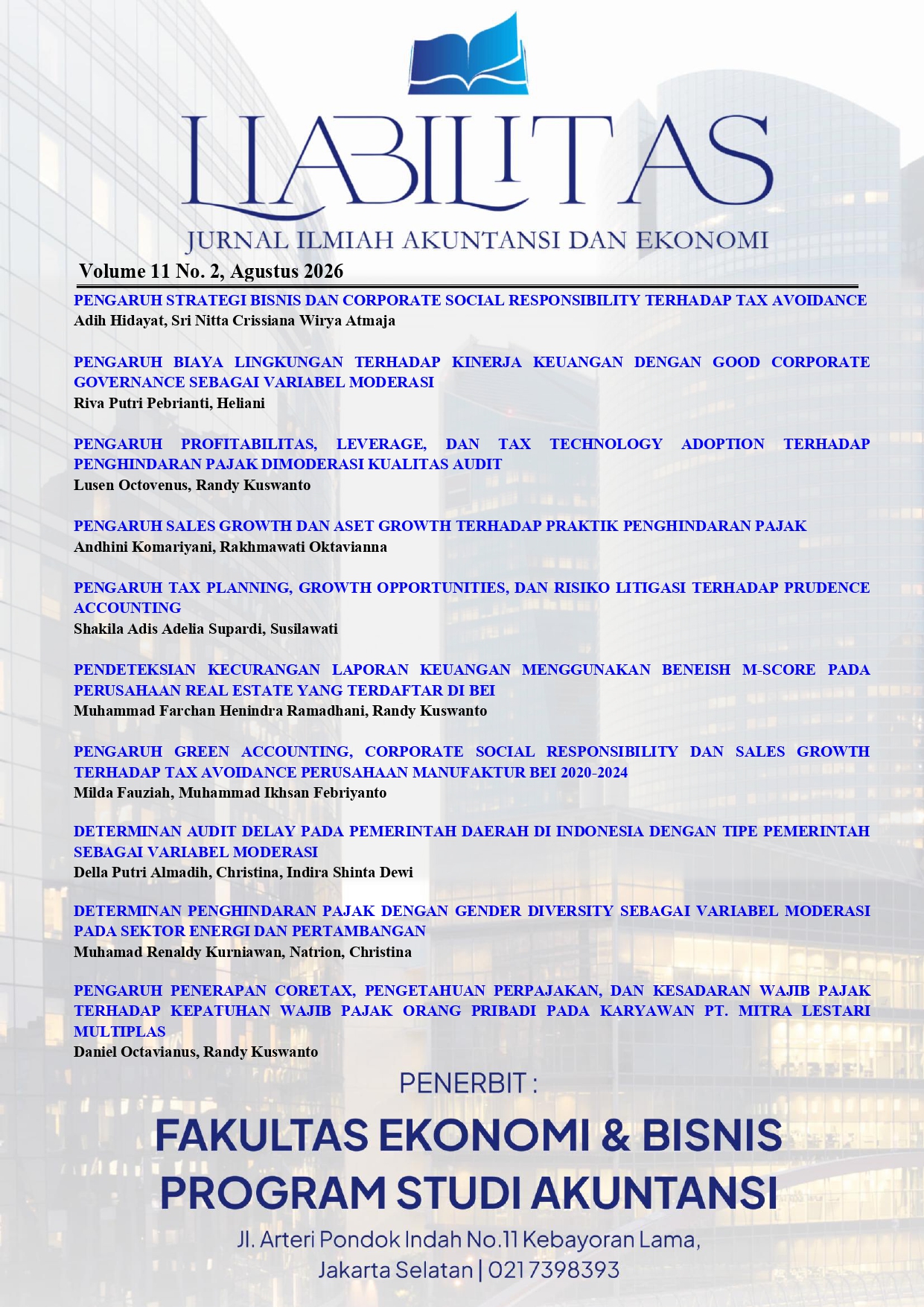
Pendeteksian Kecurangan Laporan Keuangan Menggunakan Beneish M-Score Pada Perusahaan Real Estate Yang Terdaftar Di BEI
DOI:
https://doi.org/10.54964/liabilitas.v11i2.752Keywords:
Beneish M-Score, Financial Statement, Real EstateAbstract
The Beneish M-Score is a widely used financial statement analysis tool for detecting earnings manipulation. Developed by Messod D. Beneish, a professor at Indiana University, the model draws on eight financial ratios to distinguish firms that have manipulated earnings from those that have not.This study examines real estate and property companies listed on the Indonesia Stock Exchange (IDX) using financial statements for 2023 and 2024. From a population of 89 listed real estate and property companies, 76 firms met the sample criteria, yielding 152 firm-year observations. The eight indicators applied were the Days' Sales in Receivables Index (DSRI), Gross Margin Index (GMI), Asset Quality Index (AQI), Sales Growth Index (SGI), Depreciation Index (DEPI), Sales, General and Administrative Expenses Index (SGAI), Leverage Index (LVGI), and Total Accruals to Total Assets Index (TATA), combined into an overall M-Score.Using the -2.22 threshold, 28 of 76 companies (36.8%) were classified as manipulators in 2023 and 24 companies (31.6%) in 2024, with 11 companies flagged as manipulators in both years. The remaining companies were classified as non-manipulators.
References
Association of Certified Fraud Examiners. (2016). Report to the Nations on Occupational Fraud and Abuse. ACFE.
Association of Certified Fraud Examiners Indonesia Chapter. (2019). Survai Fraud Indonesia 2019. ACFE Indonesia Chapter.
Beneish, M. D. (1999). The Detection of Earnings Manipulation. Financial Analysts Journal, 55(5), 24-36.
Christy, Y. E., & Stephanus, D. S. (2018, Maret 1). Pendeteksian Kecurangan Laporan Keuangan dengan Beneish M-Score Pada Perusahaan Perbankan Terbuka. Jurnal Akuntansi Bisnis, 16(1), 19-41.
Cressey, D. R. (1953). Other People's Money: A Study in the Social Psychology of Embezzlement. Free Press.
Darmawan, A. Z. (2016). Analisis Beneish Ratio Index Untuk Mendeteksi Kecurangan Laporan Keuangan. Jurnal Profita, 6.
Dechow, P. M., Ge, W., Larson, C. R., & Sloan, R. G. (2011). Predicting Material Accounting Misstatements. Contemporary Accounting Research, 28(1), 17-82.
Jensen, M. C., & Meckling, W. H. (1976). Theory of the Firm: Managerial Behavior, Agency Costs and Ownership Structure. Journal of Financial Economics, 3(4), 305-360.
Kartikasari, R. N., & Irianto, G. (2010, Agustus). Penerapan Model Beneish (1999) dan Model Altman (2000) dalam Pendeteksian Kecurangan Laporan Keuangan. Jurnal Akuntansi Multiparadigma, 1(2).
Kurnianingsih, H. T., & Siregar, M. A. (2019). Metode Beneish Ratio Index dalam Pendeteksian Financial Statement Fraud (Studi Kasus Perusahaan Konsumsi di Bursa Efek Indonesia). Jurnal Riset Akuntansi Multiparadigma (JRAM), 6(1).
Pernyataan Standar Akuntansi Keuangan (PSAK) No. 1. (2015). Penyajian Laporan Keuangan. Ikatan Akuntan Indonesia.
Rezaee, Z. (2005). Causes, Consequences, and Deterrence of Financial Statement Fraud. Critical Perspectives on Accounting, 16(3), 277-298.
Skousen, C. J., Smith, K. R., & Wright, C. J. (2009). Detecting and Predicting Financial Statement Fraud: The Effectiveness of the Fraud Triangle and SAS No. 99. Corporate Governance and Firm Performance, 13, 53-81.
Spathis, C. T. (2002). Detecting False Financial Statements Using Published Data: Some Evidence From Greece. Managerial Auditing Journal, 17(4), 179-191.
Widowati, A. I., & Oktoriza, L. A. (2021). Pendeteksian Kecurangan Laporan Keuangan dengan Benish M-Score pada Perusahaan yang Terdaftar di Bursa Efek Indonesia. SOLUSI: Jurnal Ilmiah Bidang Ilmu Ekonomi, 19(1), 1-11.
Downloads
Published
How to Cite
Issue
Section
License
Copyright (c) 2026 Jurnal Liabilitas

This work is licensed under a Creative Commons Attribution-NonCommercial-ShareAlike 4.0 International License.