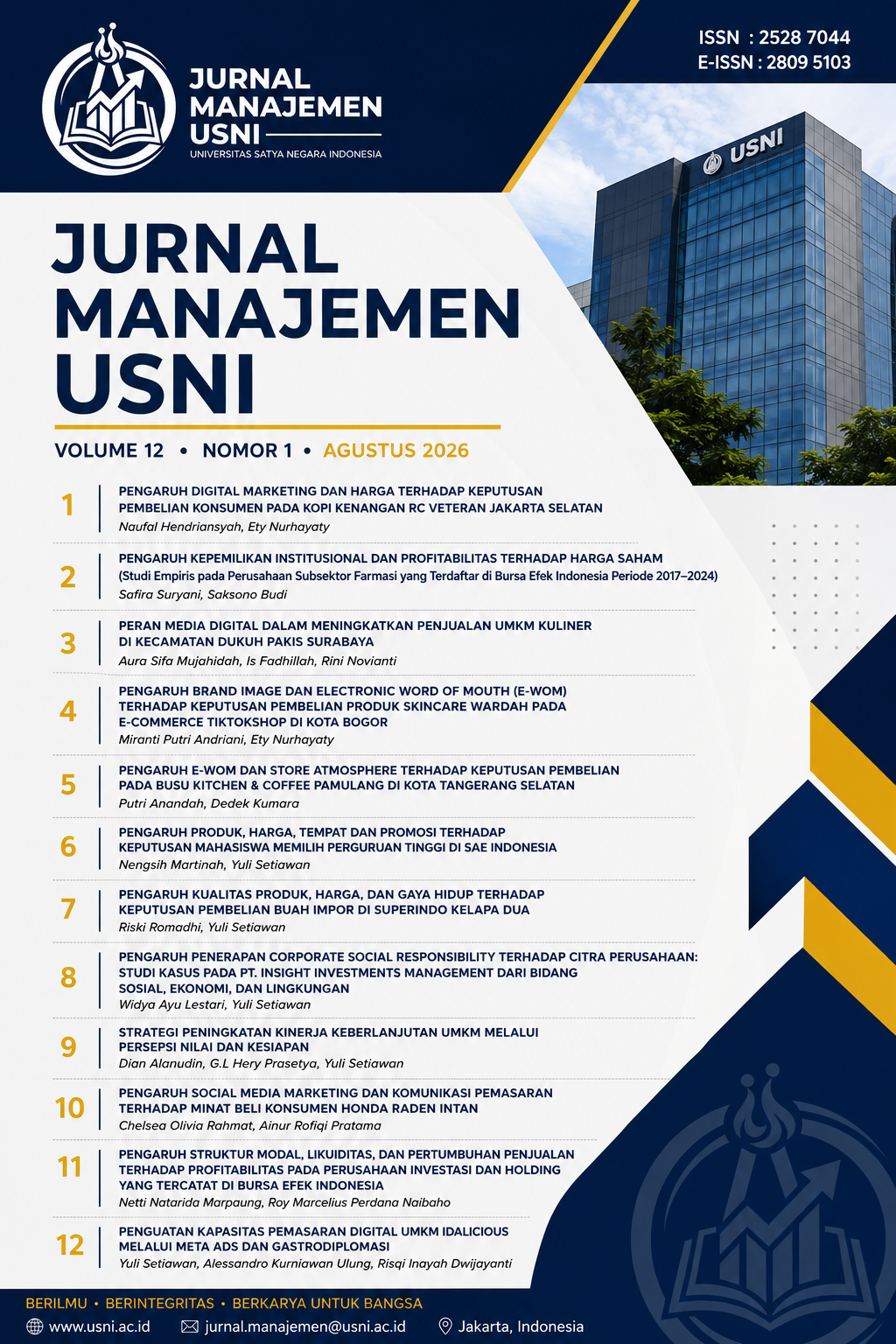
STRATEGI PENINGKATAN KINERJA KEBERLANJUTAN UMKM MELALUI PERSEPSI NILAI DAN KESIAPAN
DOI:
https://doi.org/10.54964/manajemenusni.v12i1.777Keywords:
organizational readiness, perceived value, SMEs, sustainability performance, fisheries by-productsAbstract
This study develops a managerial strategy for improving the sustainability performance of fisheries by-product–based small and medium-sized enterprises by focusing on perceived sustainability value and organizational readiness. Unlike a broader integrative-model study using the same survey context, this article applies a focused hierarchical regression and commonality analysis to identify the unique and shared contributions of the two strategic factors. Data from 100 owners or managers were collected through a five-point Likert questionnaire. The constructs demonstrated adequate reliability, with Cronbach’s alpha values ranging from 0.776 to 0.815. Perceived sustainability value and readiness jointly explained 56.13% of the variance in sustainability performance. Perceived value had the larger standardized effect, while readiness added a smaller but statistically significant contribution. Commonality analysis revealed that most of the explained variance was shared by the two predictors, indicating that awareness without implementation capability or readiness without a clear value proposition is insufficient. The findings support an integrated strategy combining sustainability-value communication, managerial capability, operational procedures, and performance measurement.
References
Agyabeng-Mensah, Y., Afum, E., & Sam, A. (2024). Eco-dynamic capability: A surest way to sustainability performance of SMEs. International Journal of Small Business and Entrepreneurship, 2(1), 24–46.
Appiah-Kubi, E. (2025). Stakeholder pressure and SMEs sustainability information disclosures: Why perceived benefits and sustainability knowledge matter. Journal of Accounting & Organizational Change, 21(3), 407–423. https://doi.org/10.1108/JAOC-11-2023-0191
Demko-Rihter, J., & Terzić, S. (2023). A framework to assess manufacturers’ circular economy readiness: A conceptual model for manufacturing SMEs. Sustainability, 15, 6982. https://doi.org/10.3390/su15086982
FAO. (2020). The state of world fisheries and aquaculture 2020: Sustainability in action. Food and Agriculture Organization of the United Nations. https://doi.org/10.4060/ca9229en
Geissdoerfer, M., Savaget, P., Bocken, N. M. P., & Hultink, E. J. (2017). The circular economy—A new sustainability paradigm? Journal of Cleaner Production, 143, 757–768. https://doi.org/10.1016/j.jclepro.2016.12.048
John, I. B., Adekunle, S. A., Aigbavboa, C. O., & Thwala, W. D. (2023). Adoption of circular economy by construction industry SMEs: Organizational and institutional readiness. Sustainability, 15, 5929. https://doi.org/10.3390/su15075929
Lopez-Torres, G. C., Garza-Reyes, J. A., Maldonado-Guzman, G., Kumar, V., Rocha-Lona, L., & Cherrafi, A. (2023). The impact of SMEs’ sustainability on competitiveness. Measuring Business Excellence, 27(1), 107–120. https://doi.org/10.1108/MBE-12-2021-0144
Nimon, K., & Reio, T. G. (2011). Regression commonality analysis: A technique for quantitative theory building. Human Resource Development Review, 10(3), 329–340. https://doi.org/10.1177/1534484311411077
OECD. (2021). No net zero without SMEs: Exploring the key issues for greening SMEs and green entrepreneurship. OECD SME and Entrepreneurship Papers, No. 30. OECD Publishing. https://doi.org/10.1787/bab63915-en
O’Reilly, S., O’Dwyer, B., & Unerman, J. (2025). Accounting practitioners’ perspectives on small- and medium-sized enterprise environmental sustainability reporting. Journal of Applied Accounting Research, 26(6), 26–46. https://doi.org/10.1108/JAAR-08-2023-0250
Sassanelli, C., Rosa, P., Rocca, R., & Terzi, S. (2023). Circular economy and sustainable business performance management in SMEs. Sustainability, 15, 8619. https://doi.org/10.3390/su15118619
Taber, K. S. (2018). The use of Cronbach’s alpha when developing and reporting research instruments in science education. Research in Science Education, 48, 1273–1296. https://doi.org/10.1007/s11165-016-9602-2
Downloads
Published
How to Cite
Issue
Section
License
Copyright (c) 2026 Dian Alanudin, G.L Hery Prasetya, Yuli Setiawan

This work is licensed under a Creative Commons Attribution-NonCommercial-ShareAlike 4.0 International License.